Friday, November 29, 2019

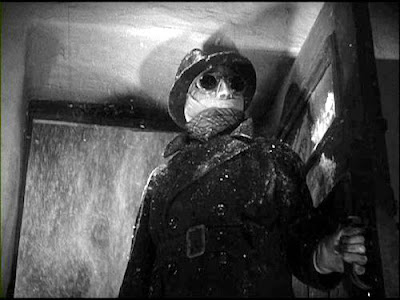
THE INVISIBLE MAN (1933)


THE CREEPING BRIDE: Probably as a result of the popularity of SHOCK!, rumors began to spread in 1958 that a number of horror and sci-fi shows were being planned for the new Fall season. When autumn came, some TV writers mentioned how surprised they were that so few of these programs actually turned up on the small screen. One of those that did was a half-hour British television series that had been picked up by CBS called "The Invisible Man." CBS first began airing it in early November 1958, not too long after Universal's THE INVISIBLE MAN first appeared on TV as part of SHOCK! films.

Indiana [PA] Evening Gazette, Wednesday December 3, 1958

Directly below that listing, this movie theater double-feature ad appeared:

What a fun couple of days that must have been in Indiana, PA!

Unlike Universal's remarkable horror film of the same name, the TV series "The Invisible Man" was a fantasy-spy show. Rather than a crazed chemist going on a murderous rampage, the scientist in the television series is a respectable, trusted, and stable chap who agrees to do Cold War missions for British intelligence after he has been irreversibly rendered transparent in a lab accident involving radioactive materials. Originally, CBS had intended to follow "The Invisible Man" on Wednesday nights with a second fantasy-spy series called "World of Giants"; produced by Ziv, "World of Giants" featured a secret agent who had been miniaturized down to six inches following his exposure to experimental missile fuel while behind the Iron Curtain, an obvious take-off on THE INCREDIBLE SHRINKING MAN (1957). The pairing of "The Invisible Man" and "World of Giants" on CBS never happened because of the programming emergency that erupted in 1958 when a series of corruption scandals connected to TV quiz shows forced abrupt cancellations that had networks scrambling to fill slots. ("World of Giants" ended up being first-run in syndication in Fall 1959 rather than on network telecast.)

"The Invisible Man" show was the creation of Ralph Smart, who later went on to make the great "Danger Man" ("Secret Agent" in the US) series with Patrick McGoohan. A young Brian Clemens worked as a writer on "The Invisible Man," as well; Clemens is responsible for a number of classic action-adventure British TV series of the 1960s and 1970s, such as "The Avengers," "The Protectors," "The Professionals," and "The Persuaders." Despite such an impressive pedigree, however, "The Invisible Man" didn't impress: one syndicated TV columnist dismissed it out of hand as "juvenile" fare, while another writer for UPI called it "really more of a short-circuit" than "a shocker." The critic goes on to say that "it's not that there isn't a kernel of an idea in the Invisible Man bit. Witness the crackly old Claude Rains movie." The TV series, however, is "completely uncrackly" because the writing "is simply absurd-- heavy-footed and clodpated."

I admit that I wasn't too sure what was meant by "crackly" in this context, but after looking it up (I also had to look up "clodpated," which I first read as "coldplated," for some reason), I think that it is a good adjective to describe Uni's THE INVISIBLE MAN: the writing of the dialogue and the action is crisp, sharp, sprightly, neat, and clever. Even on television and interrupted with commercials, the movie clips along nicely and keeps you engaged. The same can't be said of the episodes of "The Invisible Man" that I watched on-line-- television, of course, has always been (and still is) a stiflingly conservative medium, so it's probably unfair in the first place to even think that a TV show about a heroic British spy could compete with the late-night movie lunacy of this James Whale motion picture.

In addition to the crackly writing, you also have to marvel at some of the performances that Whale drew from his cast. Claude Rains' Jack Griffin dominates the proceedings with his manic mood swings from growling threats to hysterically over-the-top proclamations ("Even the Moon is frightened of me!"), all of which is punctuated by his tittering cackles and megalomaniacal braying. I find these outbursts to be equally unnerving and funny during his freak-outs, and it's hard to keep your eyes off of this see-through terrorist. But I also really like William Harrigan's performance as Kemp in the almost totally wordless scenes when he first encounters the unseen naked maniac. Harrigan's physical reactions as he interacts with another actor that is not actually in his study (as well as the later scene where he walks from the car to the Lion's Head to retrieve Griffin's notebooks) is a very convincing performance (Harrigan's later hysterical scenes with the police aren't at all as interesting).

Whale's film is dense with these kinds of fabulous things, all of which add up to make THE INVISIBLE MAN so compellingly watchable. Watering all that down into a half-hour spy show is just a bad idea all around since comparisons would be inevitable, and one needed only turn in to SHOCK! to see the superior original.


Gazette-Mail, Charleston WV, November 15, 1959
A final note: the other day I saw TCM's annual musical memorial montage listing many of the prominent film folks who have passed away during the previous year. Naturally, TCM editors chose something from TITANIC to commemorate Gloria Stuart (who died in late September at the age of 100) and that's a completely understandable decision. But wouldn't it have been great to show her in THE OLD DARK HOUSE, SECRET OF THE BLUE ROOM or THE INVISIBLE MAN? Whale doesn't give her much to do in THE INVISIBLE MAN except look luminescent and outrageously desirable, but she does that so well...


*     *     *

Trailer and Ads

A fan produced trailer by Jeff Hollis and Eric Stormoen.

 The Star Press, March 11, 1934

The Akron Beacon Journal, Dec 15, 1933


Tuesday, November 26, 2019

MYSTERY OF THE WHITE ROOM (1939)

THE CREEPING BRIDE: The "white room" of the title is the operating room where Dr. Finley Morton is stabbed in the back with a scalpel during surgery on a rich society woman. By the time the operation is over, hard-boiled big city police Sergeant MacIntosh Spencer has arrived and is untangling the various relationships of the doctors and nurses in the operating room in order to find a motive. It is the usual soap opera-- some of doctors and nurses are romantically involved with one another; two rival doctors are competing for the big promotion that Morton is helping to decide; there are senior medicos with a complicated professional relationship involving medical ethics, jealousy, and a five year-old botched surgery; and there's even a skulking senior medical staff superintendent thrown in for good measure. One of the most likely suspects is the dashing Dr. Bob Clayton (Bruce Cabot), but he confounds Sgt. Spencer by trying to solve the case on his own with the help of his lover, Nurse Carole Dale (Helen Mack). There is also an irritating comedy relief couple consisting of a meddlesome half-witted ambulance attendant (Tom Dugan) and a braying, grating nurse (Mabel Todd), but the less said about these two, the better.

The Daily Times-News, Burlington NC, October 28, 1939, seven months after MYSTERY OF THE WHITE ROOM was released theatrically

The only witness that can help solve the Morton murder is Tony the deaf janitor; the killer tries to do away with Tony by viciously smashing a bottle of acid into his face, an attack that leaves Tony blind, unable to speak, and paralyzed. This surprising bit of nastiness is one of the fleeting grotesque touches in MYSTERY OF THE WHITE ROOM that makes this whodunit into something different from the usual fare. The other bit of pulp wackiness is the lurking scalpel-wielding murderer; on the eve of an corneal transplant operation (using Morton's dead man's eyes) that will hopefully restore Tony's sight and allow him to recognize his attacker, the shadowy, surgical-glove-wearing killer appears in the middle of the night on the fire escape outside of Tony's room and hurls a scalpel at him through some venetian blinds.


But none of these almost-horror tweaks is enough to make MYSTERY OF THE WHITE ROOM into anything other than a B-movie murder-mystery of the 1930s. The cast is interesting one that connects MYSTERY OF THE WHITE ROOM to KING OF THE ZOMBIES, KING KONG, SON OF KONG, MYSTERY OF THE WAX MUSEUM, DR. X, HOUSE OF FEAR, MARK OF THE VAMPIRE, GHOST OF FRANKENSTEIN, THE MUMMY'S CURSE, MAN MADE MONSTER, VALLEY OF THE ZOMBIES, and some of other things, but there's really not a whiff of horror to be had despite the best efforts of some TV horror hosts over the years.
San Antonio [TX] Express, May 2, 1958
The copy in this oddly-shaped ad reads in part: "A mystery 'Shock' thriller about the terror that stalks the corridors of a hospital. To bed before the Witching Hour"


Daily Review Hayward, CA, April 9, 1960

The Capital, Annapolis, MD, December 22, 1973

MYSTERY OF THE WHITE ROOM was one of three "Crime Club" movies that Screen Gems had bundled into the SHOCK! assortment for TV (Universal made eight all together between 1937-39 and MYSTERY OF THE WHITE ROOM was the second to last). Mirek mentioned the "Crime Club" series in a post here two and a half years ago; the helpful "Crime Club" blog sketches out the history of Doubleday's series and includes mention of both the Universal film series and the radio show (CBS 1931-32; Mutual 1946-47). According to that blog, Universal subcontracted Irving Starr Productions to make the films and retained control over only half of them later on, with the last three being sold off to Screen Gems in 1957. I know nothing about the history of the book series' sales figures or its popularity in the late 1950s-- would knowing that this was a "Crime Club" movie draw in viewers to the SHOCK! telecast? I didn't see any promotion of that angle in the television listings, so maybe not...

From the perspective of 2011, the copyright business seems tangled enough to doom MYSTERY OF THE WHITE ROOM to never appear on legitimately-licensed DVD. There's not a big market for obscure B-movie thrillers these days, particularly those that would require some expensive legal wrangling to secure the rights. That's unfortunate, because this might be the best of the "Crime Club" bunch-- once the relationships between all the characters are established in the first reel, this 58-minute film plugs right along and does its damnedest to cover up some of its flaws in narrative logic. And the sprinkles of weirdness help this one go down easy on late-night viewing.

(As a footnote to this, let me add that any viewer interested in seeing a murder-mystery set in a hospital ought to check out the well-made British film GREEN FOR DANGER [1946].)


*****

Trailer, Ads


 The Jackson Sun, Oct 29, 1939

The News Leader, May 11, 1939

Saturday, November 23, 2019

House of Frankenstein AND House of Dracula Trailers


What better way to evoke the SHOCK! lifestyle than by presenting two trailers from Universal's classic Frankenstein monster series--one for the 1944 HOUSE OF FRANKENSTEIN and the other for the 1945 HOUSE OF DRACULA. These are not the original trailers, btw, but those used by Realart Pictures, who re-released the films and used the original promo materials. If you pay attention, you'll notice another actor, rather than Glenn Strange, as the Frankenstein Monster at the end of the HOUSE OF DRACULA trailer. This actor played the Monster in another Universal movie, a clip from which was used for the HOUSE film.

Wednesday, November 20, 2019

Who is this Roland guy?

The Philadelphia Inquirer, May 29, 1958

The Philadelphia Inquirer, May 29, 1958


SHOCK! Ballyhoo (#3): Good Night, Nurse!

THE CREEPING BRIDE: OK, technically, this is not SHOCK! ballyhoo--- it is from the "Showmanship" section of a theatrical pressbook for THE WOLF MAN and is intended for patrons in movie theater lobbies rather than TV viewers in 1957: a "first-aid booth" with cigarettes and chewing gum to soothe the nerves, candles for those afraid of the dark, spirits of ammonia (smelling salts) to bring consciousness back to those who have fainted out of fear, dye for those whose hair turned white from fear, and so on.

Though it was intended for movie-theater publicity well before the movie's stint on TV, I just can't resist including this here as part of my look at THE WOLF MAN on SHOCK!. For one thing, I like the explicit mention here of treating "those who suffer from 'thrill-shock'"--- I've been gathering stuff like this for a future web log entry on how the word "shock" was used (by Universal , Film Classics, and Realart) for horror films of the '30s and '40s and how this usage may have informed Screen Gems decision to title the syndication package SHOCK! in 1957. (Another example of "shock talk" from THE WOLF MAN's pressbook appears below.)


SHOCK! Ballyhoo (#2): Frankenstein's Monster at the World Series

THE CREEPING BRIDE: I overheard two women on the bus this afternoon talking about the Major League Baseball's on-going World Series and I took that as a timely reminder to bring up this photo of a SHOCK! publicity stunt:

As you can see, someone dressed as Frankenstein's Monster slouches in a folding chair near a beach umbrella, attached to which is a banner reading "Channel 7 Brings SHOCK! Oct. 3rd 11:15 PM"; a thermos of coffee and a tray of food are set out nearby. Behind the Monster is the Yankee Stadium box office-- supposedly, starting on September 21, the Monster waited on line in the Bronx for three days to buy tickets for bleacher seats for the opening game of the 1957 World Series between the New York Yankees and the Milwaukee Braves (Yankees won 3-1; there's no word if the Monster ever showed up for the game).

The origins of this photograph apparently lie in an article in the SHOCK! promo book called "Audience Promotion to Excite Your Public" under the subsection "Direct Audience Exploitation." Here, the crew at Screen Gems suggests:

"Frankenstein's Monster is first in line at a box office waiting to buy a ticket in a sporting event or an important theatrical opening. The monster has arrived in an ambulance. At regular intervals, an intern wearing a white jacket will come out of the ambulance to feed the monster. (The longer the monster has to wait the better the stunt.)"

Previously when I had seen the photo, I just figured that someone at WABC-Channel 7 had cooked up the stunt. But the SHOCK! promotions booklet indicated that the origins for the idea came from Screen Gems. I thought, then, that I had found an instance where one of the strange publicity strategies that Screen Gems had brainstormed had been picked up by a TV station and put to use.

But then I read this news report in Billboard: The Amusement Industry's Leading Newsweekly, which stated that the Yankee Stadium ballyhoo was orchestrated by Screen Gems itself for the SHOCK! syndication package and not by TV station WABC as I had first thought.
Billboard, September 23, 1957

(And not surprisingly, this teaser advertisement for SHOCK! appeared in Billboard three pages after the above story:)


I've heard people say that they remember seeing that photograph of the Monster sleeping out for tickets in Fall television guides newspaper supplements in cities far from NYC-- have you seen that photograph before? Who is the guy in the costume? Does anyone out there know more about this stunt?

***** 

My (Mirek) original comment:

That exact photo appeared in the first issue of FAMOUS MONSTERS. One full page. The caption read:

"Shocking! Sleeping on the job? Frankly, he may get fired from the Monsters Union for this! (Wonder if monsters have nightmares about people when they dream?)

Excellent work, Creeping Bride, tracking down the fact that this type of promotion actually occurred. 

Creeping Bride's response:

I know almost nothing about the horror-magazine craze of the late '50s - '60s, so I'm glad that you brought this up, Mirek. I'm sure that a few other monster-mags repro'ed that photo as well.

I realize that it's critical for me to understand more about the history of monster-mags for my investigation of the Monster Culture revolution, so I'm slowly teaching myself about it by reading blogs like "Monster Magazine World" and Mike Scott's "Monster Magazines." I hope that monster-mag fans will check in and add information as I work through the SHOCK! and Son of SHOCK! titles, since I know there was a great deal of synergy there between the TV broadcasts and the magazines. 

Monday, November 18, 2019

SHOCK! Ballyhoo (#1): A Fistful of Tranquilizers

THE CREEPING BRIDE: In the booklet that Screen Gems sent out to television stations in 1957 in order to drum up interest in the SHOCK! syndication package, there were a number of suggestions for publicity stunts. Some of these promotions were intended to be sensationalistic and attention-grabbing, whereas others just seemed bizarre. As part of my viewing project in the months to come, I will occasionally post about some of the schemes that had been developed by Screen Gems and by local television stations in order to whip up (viewer and sponsor) interest in these films.

Today's ballyhoo entry comes from the folks at Screen Gems and was included in a list of suggestions on a page titled "Shock Showmanship: Sales Promotion to Enthuse Your Sponsors." The article recommends throwing a party in a studio at the station "for the night of your premiere telecast" of the SHOCK! series. Among the ideas that the booklet offers for decoration and for guest refreshment is the following:
"Bottles labeled 'POISON,' bowls of aspirin and milltown [sic], and a bucket of ketchup labeled 'BLOOD' should be placed a convenient spots for the use of your guests."
The casual mention of "milltown" in this piece caught my eye. I remembered that Miltown (capital "M" and one "L"-- it is misspelled in the SHOCK! booklet) is the brand-name for a tranquilizer pill; I assumed that the tranq was a prescription medication, so I was a little amazed by the publicity guys' suggestion that your station should put out bowls of them for your party guests as if they were M&Ms-- notice that the promo copy doesn't say "label a bowl of aspirin as 'Miltown' " the same way that they recommended labeling bottles as "poison" or buckets of ketchup as "blood." Can you imagine a publicity campaign today that suggested that a TV station set out candy dishes of Rohypnol and Xanax for party-goers?

This suggested to me that you could obtain a bowl's-worth of Miltown in 1957 with the same non-prescription ease as which you could aspirin. Curious about this, I did a little bit of research. What I found surprised me; most of what I discuss below I found in the pages of Professor Andrea Tone's quite engaging 2009 study, The Age of Anxiety: A History of America's Turbulent Affair with Tranquilizers.


Miltown (the name under which the psychotropic compound meprobamate was marketed by Wallace Laboratories) was first concocted in 1950, tested on psychiatric patients for a few years, and then released to the public by the FDA in 1955 for use in treating stress, anxiety, insomnia, tension, stage-fright, and even shyness. It surprised everyone by becoming a wildly popular drug and, as such, a trailblazer in the bestselling "life-style" drugs that today permeate the landscape in the US (i.e., Prozac; Viagra; Ambien).

In her book, Andrea Tone explains the wide-spread consumption of Miltown by triangulating it between (1) the move of family physicians into the field of treating mental health issues (formerly the purview of expensive psychiatrists and Freudian psychoanalysts), (2) the efforts by pharmaceutical manufacturers and drugstore owners to find a hot-ticket item in the consumer marketplace, and (3) the thick atmosphere of worry and fear felt by the general public in the mid-1950s because of the anxieties over H-Bombs, the existential emptiness of the gray-flannel-suited rat race (Miltown was nicknamed "Executive Excedrin"), and the frantic pressures of consumer culture suburbia. Before it was eclipsed by Librium and Valium in the early 1960s, Miltown was "Mother's little helper" and the drug of choice of "overworked businessmen harried by office deadlines, virgin brides nervous about their honeymoons, petulant toddlers and teenagers, and Americans fearful of nuclear annihilation" (Tone cites a number of articles that arrive at the same conclusion as this 1958 article in the New Yorker magazine: "An age in which nations threaten each other with guided missiles and hydrogen bombs is one that can use any calm it can get, and calm is what the American pharmaceutical industry now abundantly offers.") A 1957 Gallup Poll found 7 million Americans admitting to having used the drug.


A 1956 Charles Addams cartoon for New Yorker from Tone's book. The commuting businessman in the subway station encounters a vending machine of refreshments for either going to work or for going back home at night: phenobarbital (a barbiturate), Miltown, Doriden (a sleeping pill), and benzedrine (speed). A 1957 survey of American businessmen found that 72% of respondents felt that tranqs improved performance at work.

As I suspected, Miltown was only available by doctor's prescription, but as Tone illustrates in her book, "tranquilizers were easy to get because doctors prescribed them liberally and pharmacists often refilled prescriptions without authorization [...] One Hollywood reporter identified only one prescription out of the fifty tranquilizer users he interviewed in 1956."

Tone devotes a chapter on how Hollywood's torrid love affair with this "relaxed energy" tranquilizer pill was such that it had normalized it in a way that made it seem like it was an over-the-counter remedy. Miltown was cheap (nine cents, "about the same price as a can of tomatoes or a roll of toilet paper at the neighborhood Safeway") and easily obtained with or without prescription-- Tone says that Schwab Drugstore sold more than 250,000 tablets in four months during the winter of 1955-56. Lucille Ball, Lauren Bacall, Tennessee Williams, Tallulah Bankhead, Red Skelton, and Bob Hope talked about it. Milton Berle frequently joked about changing his name because of the amount he needed to ingest in order to do his TV show on the air; Jerry Lewis, Jimmy Durante, and Robert Cummings had made so many jokes about Miltown during the Oscar and Emmy Award ceremonies in 1955 that the FDA launched an investigation into the possibility of there being a massive celebrity endorsement scheme. The jewelers Cartier and Tiffany marketed pill boxes and charm bracelets for one's Miltown stash; 1956-57 advertisements for Baskin-Robbins ice cream recommended that a gallon of Hazelnut Toffee Ice Cream was as relaxing as a dose of Miltown.

from Tone's book: photo of Uncle Miltown as it appeared in Time magazine,
27 February 1956

You get the picture... Miltown, though largely forgotten today, was huge in the mid- to late-1950s. The publicity people at Screen Gems tapped into the trend; they encouraged stations to hype the horrors of SHOCK! to advertisers by creating a "haunted house" atmosphere and jokingly offering Miltown at launch parties in order to calm themselves after being subjected to the terror of these movies. Here, then, is a case of US pop culture collision, where the Monster Revolution of the mid-'50s intersected with what one psychiatrist quoted by Tone called the Tranquilizer Revolution.

(And given some of the low-grade B pictures in the SHOCK! package, I can't resist this February 1957 quote that Tone found by Aldous Huxley. Huxley, encouraged by the fact that "more than a thousand million doses of meprobomate were swallowed last year by the American public," said he looked forward to the day when a new class of drugs would emerge that would be a "transfigurer of perceived reality," capable of "imparting to the most dismal or commonplace scene unsuspected and unimaginable qualities of beauty-- even of making the average TV program seem absolutely wonderful.")

detail from an advertisement for a Payless Drug Store in Oakland, CA, 1956


***** 

The Morrison Transcript, July 18, 1957

The Tennessean Sun, March 17, 1957

Mt Vernon Register News, March 1, 1960

WEIRD WOMAN (1944)

  THE CREEPING BRIDE: Monroe College sociology professor Norman Reed (Lon Chaney, Jr.) is jinxed. A "mental giant...